If you've ever noticed green or red lights flashing from the underside of your smartwatch, smart band, or smart ring, you may have wondered: Are those lights safe for your skin? The good news is that these lights are part of a well-established optical sensing technology used in many wearable devices. They are designed to interact with the skin and underlying tissue to collect information such as heart rate and, on supported devices, blood oxygen levels. Let's understand what these lights actually do and what you should know about wearing a smart band regularly.
What Are the Green and Red Lights on a Smart Band?
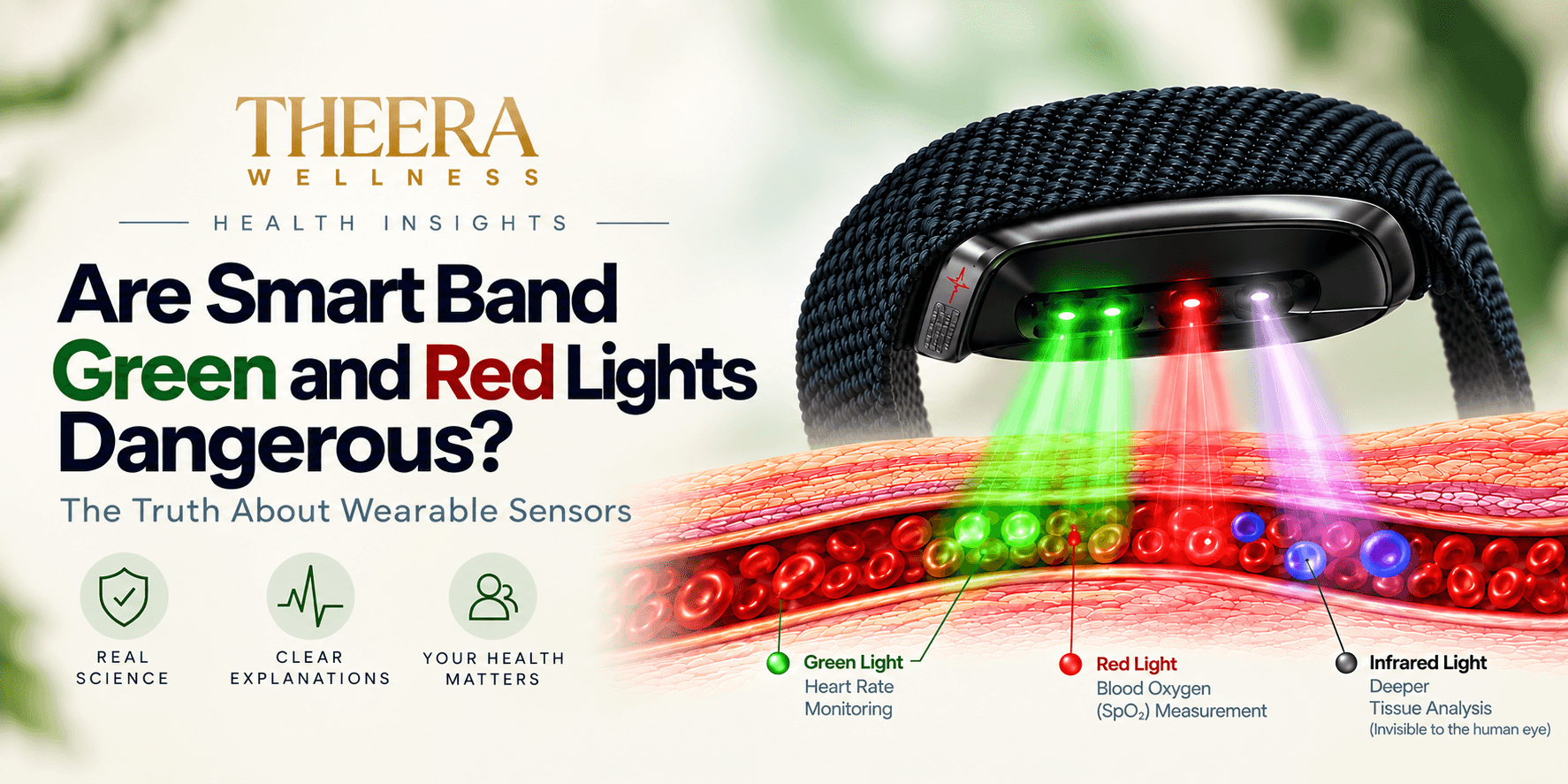
The sensors on the underside of many smart bands and smartwatches use a technique called Photoplethysmography (PPG). PPG uses light and photodetectors to detect changes in blood volume in tissue. When your heart beats, blood volume in the small blood vessels near the skin changes. The sensor detects these changes in the amount of light absorbed or reflected by the tissue and uses the resulting signal to estimate measurements such as heart rate. Different wavelengths of light can be used for different sensing applications.
Types of Light Used in Wearable Sensors
Green Light — Used Primarily for Heart Rate Monitoring
Many wearable devices use green LEDs in the approximate 525–535 nm range for optical heart-rate monitoring. Green light interacts strongly with blood and can provide a useful PPG signal from the blood vessels close to the skin. As your heart beats, blood volume in the wrist changes. This produces small changes in the light detected by the sensor's photodiode. The device processes these changes to estimate your pulse or heart rate.
Red and Infrared Light — Used for Blood Oxygen Measurements
Wearable devices that support SpO₂ measurement may use red light and near-infrared (IR) light. A commonly used red-light wavelength is around 660 nm, while near-infrared sensing may use wavelengths around 940 nm, although exact wavelengths can vary between devices. Oxygenated and deoxygenated hemoglobin have different light-absorption characteristics at these wavelengths. By comparing the optical signals, an SpO₂ sensor can estimate blood oxygen saturation. The exact implementation varies between manufacturers and devices.
Does Continuous Light Emission Affect Your Body?
For properly designed wearable devices operated as intended, the optical LEDs are generally designed to operate at low optical power and controlled exposure levels. The light used by these sensors is non-ionizing radiation. It does not have the high energy associated with ionizing radiation such as X-rays or gamma rays. However, it would be inaccurate to say that every wearable sensor is automatically safe regardless of its design. Optical exposure depends on factors such as:
- LED wavelength
- Optical power
- Exposure duration
- How frequently the LEDs operate
- Sensor design
- Distance and positioning against the skin
- Device compliance with applicable safety requirements
Therefore, the appropriate conclusion is that wearable optical sensors are designed for routine use at controlled exposure levels, rather than assuming that every LED system has identical characteristics.
Can Green or Red Light Damage Your Skin?
The green, red, and near-infrared LEDs used in wearable optical sensors are intended to provide measurements rather than heat or alter the skin. At the low exposure levels typically used in wearable sensing, the purpose of the light is to obtain an optical signal from tissue. The sensor does not need to penetrate deeply into the body to measure a PPG signal. Much of the useful signal comes from tissue and blood vessels relatively close to the skin surface. The exact depth of light penetration depends on the wavelength and the optical properties of the individual's tissue, so it should not be treated as one fixed measurement for every person or device.
What If You See Green Light Flashing at Night?
Seeing a green glow from the underside of your wearable in a dark room can look unusual, but the light is simply the sensor operating. You may notice it more clearly at night because the surrounding environment is darker. The sensor is designed to direct its light toward the skin. As with any bright light source, you should avoid deliberately staring directly into an LED at very close range for prolonged periods.
What About Red Marks or Skin Irritation?
If your wrist becomes red or irritated after wearing a smart band, the light itself isn't necessarily the cause. Skin irritation can have several common causes, including:
1. Contact Dermatitis
Sweat, moisture, heat, lotions, and prolonged contact with the strap can irritate the skin. Some people can also react to particular materials used in straps, adhesives, or metal components.
2. Friction
A band that is too tight can put continuous pressure on the skin. A band that is too loose can repeatedly rub against the wrist during movement. Both situations can contribute to irritation.
3. Allergic or Sensitivity Reactions
Certain individuals may be sensitive or allergic to specific materials, including some metals, rubber compounds, silicone formulations, or adhesives. If irritation repeatedly occurs, checking the materials used in the wearable and discussing persistent symptoms with a healthcare professional may be appropriate.
4. Sweat and Moisture
Sweat can remain trapped between the wearable and your skin, particularly during exercise or in hot and humid conditions. Prolonged moisture and friction can make irritation more likely.
5. Poor Cleaning
Dead skin cells, sweat, lotion, and other residues can accumulate on the band and the skin underneath it. Regular cleaning can help keep the contact area more hygienic.
How to Prevent Skin Irritation When Wearing a Smart Band
1. Keep the Band and Your Skin Clean and Dry
Clean the band regularly according to the manufacturer's care instructions. After exercising, dry both your wrist and the band before wearing it again. If the manufacturer permits washing the band with soap and water, follow those cleaning instructions rather than using harsh chemicals.
2. Don't Wear the Band Too Tightly
The sensor needs consistent contact with your skin, but tighter does not necessarily mean better. The band should sit securely without creating excessive pressure or leaving deep indentations.
3. Give Your Skin a Break if Irritation Develops
If you notice persistent redness, itching, swelling, or discomfort, remove the wearable and allow your skin to recover. If symptoms don't improve or repeatedly return, consider speaking with a healthcare professional.
4. Consider the Strap Material
If you repeatedly experience irritation, the material touching your skin may be a contributing factor. Choosing a strap made from a material you tolerate well can help reduce the chance of contact irritation.
Do Top Smartwatch Brands Use Safer Sensors?
Not necessarily. Many major smartwatch and wearable manufacturers use the same basic optical sensing principle: LEDs illuminate the skin and photodiodes detect the returning optical signal. However, the fact that two products use PPG does not mean their sensors are identical. Safety and performance depend on factors including:
- LED specifications
- Wavelengths used
- Optical output
- Sensor configuration
- Exposure and operating conditions
- Device construction
- Software and signal processing
- Applicable testing and regulatory requirements
So, rather than judging safety simply by the brand name, it is more useful to consider the actual design, specifications, testing, and intended use of the device.
Is Theera Wellness Smart Band Safe to Use?
The Theera Wellness Smart Band uses an optical sensing approach similar to that used in many modern wearable devices. Its optical sensors use green, red, and infrared light for supported wellness measurements. When used according to the manufacturer's instructions, these sensors are intended for routine wearable use and non-invasive optical measurements. As with any wearable device, users should follow the product's usage, cleaning, and charging instructions and pay attention to how their own skin responds to prolonged contact.
Theera Wellness is designed with everyday wellness monitoring and comfortable wearable use in mind.
A Simple Reminder About Wearable Health Measurements
Optical sensors can provide useful wellness information, but wearable measurements are not the same as clinical diagnostic testing. Factors such as movement, sensor placement, skin characteristics, ambient conditions, and device fit can affect optical measurements. If you are concerned about a health reading or are experiencing symptoms, a wearable should not replace professional medical evaluation.
Final Takeaway
The green, red, and infrared lights you see underneath a smart band are part of the device's optical sensing system. Green light is commonly used for heart-rate monitoring, while red and near-infrared light can be used for SpO₂ measurements. These are non-ionizing forms of light, and wearable optical sensors are designed to operate with controlled exposure during normal use. If you experience redness or irritation while wearing a smart band, the more likely factors to consider include sweat, moisture, friction, tightness, cleaning, or sensitivity to the strap material. There is generally no need to be concerned simply because you see the lights flashing. Understand what the sensor is doing, wear the device correctly, keep the contact area clean and dry, and pay attention to your skin's response.